
 ABOUT
ABOUTHome »
-

This is the Long & Short of it: Don’t Overpay for Beta

Kevin Gray
Chief Investment Officer
 5 min read
 This is the Long & Short of it: Don’t Overpay for Beta
This is the Long & Short of it: Don’t Overpay for Beta
‘The two greatest enemies of the equity-fund investor are expenses and emotions.’
- John Bogle
‘If returns are going to be 7 or 8% and you’re paying 1% for fees, that makes an enormous difference in how much money you’re going to have in retirement’
- Warren Buffet
‘One of the funny things about the stock market is that every time one person buys, another sells, and both think they are astute.’
- William Feather
‘The simple concept is not always best, but the best is always simple.’
- Little Gidding, TS Eliot, 1942
‘I choose a lazy person to do a hard job. Because a lazy person will find an easy way to do it.’
- Bill Gates

Equity long/short strategies are a staple of the hedge fund industry for good reason; they have historically produced higher risk-adjusted returns than equity markets themselves. Their success has been such that they are now an established part of the mutual fund industry also.
However, despite their well-established benefits at the aggregate level, investors still face several practical challenges when allocating to the strategy on an individual basis:
- Elevated fee structures
- Lack of persistence of manager-specific alpha
- Unstable betas through time
There are a number of ways to implement equity long-short, both from a philosophical and implementation perspective:
- Systematic vs discretionary
- Index vs single stock shorting
- Physical vs synthetic replication
Systematic vs Discretionary:
Both discretionary and systematic managers tend to operate on the same premise, that there is alpha to be found in isolating factor exposures. The modern factor model began with Fama and French who can lay claim to size, value and quality, with Carhart adding momentum later. This work was the first formal proof that risk premia could be decomposed into systematic factors and ‘alpha’ often stemmed from exposure to these compensated risks.
The difference in the approaches lies in the systematic approach that exposure to the factor itself is the desired outcome versus discretionary managers whose factor exposures tend to be a by-product of their stock selection. This translates into two phenomena:
1. As equity beta has historically been persistently rewarding, managers with discretion tend to run higher levels than those without, leading to reduced diversification benefits of the strategy. Active managers often deliver time-varying beta under the guise of alpha with cost structures very much suggestive of alpha generation.
2. Given the dominance of themes and factors more recently, discretionary L/S strategies and the delta1 equity allocations in multi-asset portfolios can in fact look and importantly behave similarly to each other.
Index vs Single-Stock Shorts
In most long/short implementations, the short book is where complexity and cost can accumulate. Attempting to generate alpha from single-name shorts often introduces high borrow costs, asymmetric payoffs and operational friction.
By contrast, index shorting offers a cleaner, more efficient way to manage market beta, providing:
- Beta stability – exposures can be sized or adjusted quickly, keeping portfolio risk aligned with target levels
- Lower implementation cost – no borrow fees, lower turnover, and simplified operations versus managing multiple physical short positions
- Liquidity and scalability – index swaps can absorb meaningful notional exposure without market impact
- Stability through stress – index hedges tend to maintain consistent behaviour when single-name shorts can exhibit idiosyncratic behaviours
Index shorting sacrifices the potential for idiosyncratic behaviours to translate into alpha on the short side, but replaces it with predictability, cost-efficiency and robustness; these are qualities that compound meaningfully over time.
Physical vs Synthetic Replication
Funds which synthetically replicate have no physical long book or borrow-driven shorting of equities, the economic exposure is obtained synthetically through derivative contracts, while the fund’s cash can be invested in bonds in order to earn a transparent fixed-income return.
The same structural evolution that has driven large ETF providers such as Blackrock to embrace synthetic replication for long-only index exposure applies equally to low-beta long/short portfolios. As counterparty and collateral frameworks have matured under UCITS, synthetic replication now represents the efficient frontier of index implementation, delivering more stable exposure, lower frictional costs and enhanced liquidity transparency.
A Fresh Approach:
Philosophy and objective
Fortem’s systematic equity long/short strategy is designed as a cost-efficient, stable diversifier with a construction resting upon three pillars:
1. Systematic process: A transparent, rules-based framework drives signal generation, portfolio construction, and risk management
2. Diversification integrity: The long leg targets non-growth factors which have historically shown persistence through time, preserving diversification particularly when growth dominates index returns
3. Replication efficiency: index-based synthetic replication, maintaining a stable beta and lowering costs
Structural framework
Long Leg: Systematic Factor Optimised Index Replication
- Achieved synthetically via swap and optimised for exposure to the persistent & diversifying factors of value, quality, size and momentum.
- Rules-based investment constraints ensures resilience through style rotations, preventing the style drift often seen when growth or technology leadership skews benchmark performance.
- The process emphasises objective factor persistence through time over discretionary selection which can become clouded by behavioural biases.
Short Leg: Systematic Benchmark Index Replication
- Short exposure is achieved synthetically via swap against the benchmark global equity index.
- Beta reduction versus alpha creation.
- The result is a low and stable net beta that maintains diversifying characteristics across market regimes.
Collateral
Synthetic replication frees the balance sheet of the Fund for the income portfolio. The liquidity of the Fund therefore extends to the collateral itself; short-dated, high-grade debt. When funding is tight, the Fund can also use its balance sheet to specifically take advantage of this.
Peer Comparison:
Having outlined the design and structural advantages that a systematic long/short approach can bring; stable beta, simple process, cost and liquidity efficiency, it is instructive to examine how this translates into realised outcomes when compared with peers.
An important point to note is that the Fund launched in mid-2023. Its systematic nature means a backtest can be constructed and is representative of how the strategy would have performed over the period (both the long and short indices have existed over the period), but caveats associated with backtests should still be employed.
The peer group represents a cross-section of established long/short equity managers across both discretionary and systematic implementations and is available on request. This is the peer group that was established at the launch of the Fortem Absolute Return Fund and has not been created for this piece.
The big reveal:
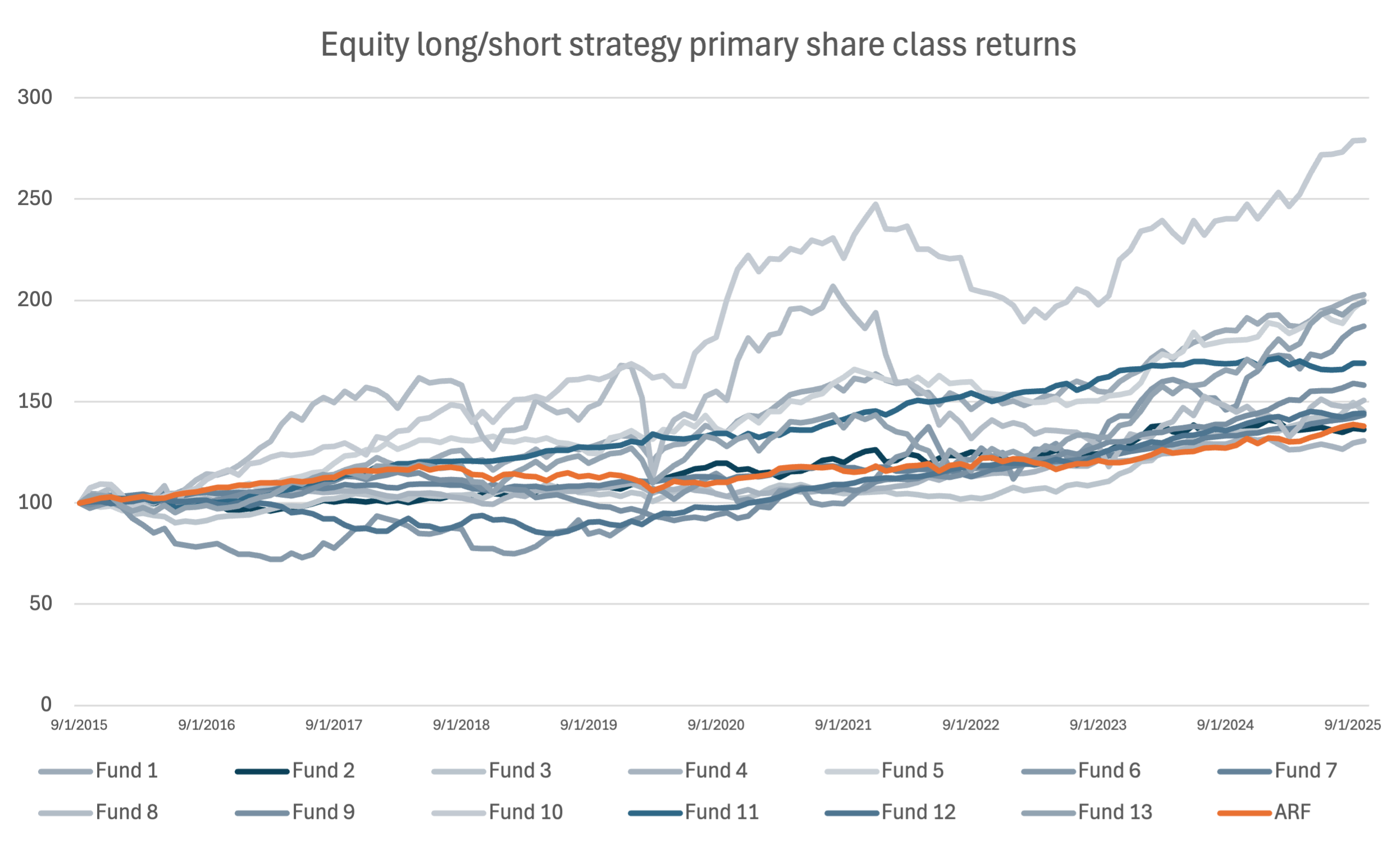
Source: IMF, Fortem Capital
Source: Bloomberg, Fortem Capital, 31.10.2015 – 31.10.2025
Absolute cumulative returns are still the lens through which the vast majority of investors will first assess equity long/short strategies.
However, absolute returns alone do not show whether a strategy provides meaningful diversification to a multi-asset portfolio. The core benefit of equity long/short lies in its risk profile; volatility, beta through time and drawdown characteristics, not simply return alone. To evaluate the value of the strategy one therefore must look beyond cumulative returns; the big reveal tells us little in reality.
Peer Comparison:
Plotting annualised return against annualised volatility highlights the return efficiency of the various implementations:
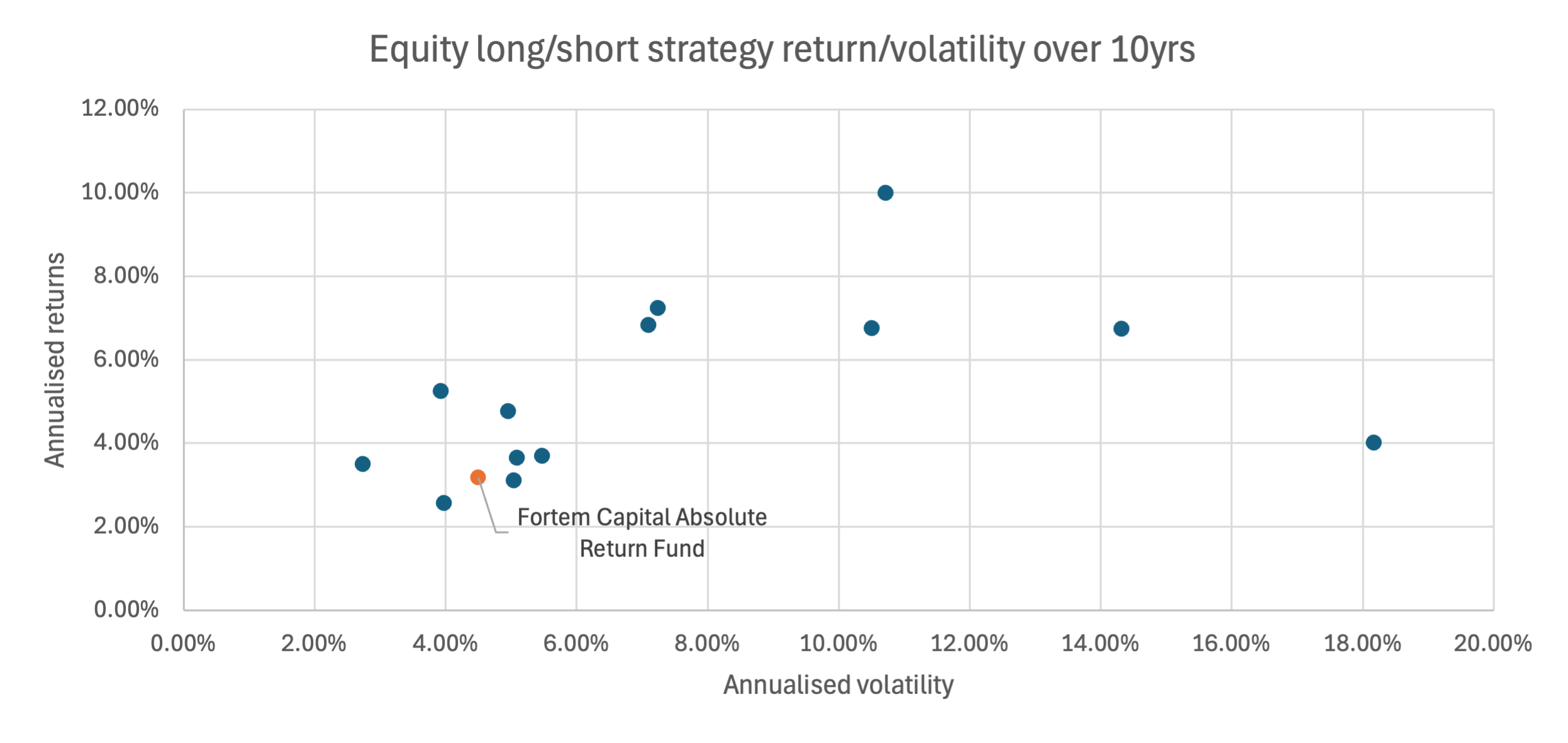
Source: Bloomberg, Fortem Capital, 31.10.2015 – 31.10.2025
It is notable that over the analysis period, the systematic long sleeve of the Fortem strategy has been in a structurally unfavourable environment, underperforming the short leg by ~ 2% p.a.(~40% cumulatively over the 10y period). This is unsurprising given large-cap growth dominance versus a long leg that specifically targets small size and non-growth factors. Despite this, the strategy has remained firmly in line with the peer group, indicating that:
- High fees across the sector have eroded much of the return premium
- A cost-efficient implementation can preserve the diversification benefit even when factor conditions are not supportive
Crucially, 2022, a year in which duration struggled as global equities fell ~18% and beta was a significant drag, saw the strategy produce a positive return. This was a period characterised by a sharp factor rotation away from growth and into value/quality, precisely the environment that rewarded the systematic long leg.
The long leg is designed to have consistently positive active exposures to value, quality, momentum and size (small versus big) versus the parent, which is now concentrated and dominated by a few stocks given that the Mag 7 accounts for more of the global equity benchmark than the stocks of Japan + UK + France + Canada + Germany combined. In order to have a diversifying exposure in one’s alternatives allocation alongside a low but positive beta, it makes sense to target factors outside of that which is driving almost every delta1 equity allocation currently.
Peer Comparison:
Those strategies which exhibit higher annualised returns also often do this via higher levels of volatility and therefore higher drawdowns:
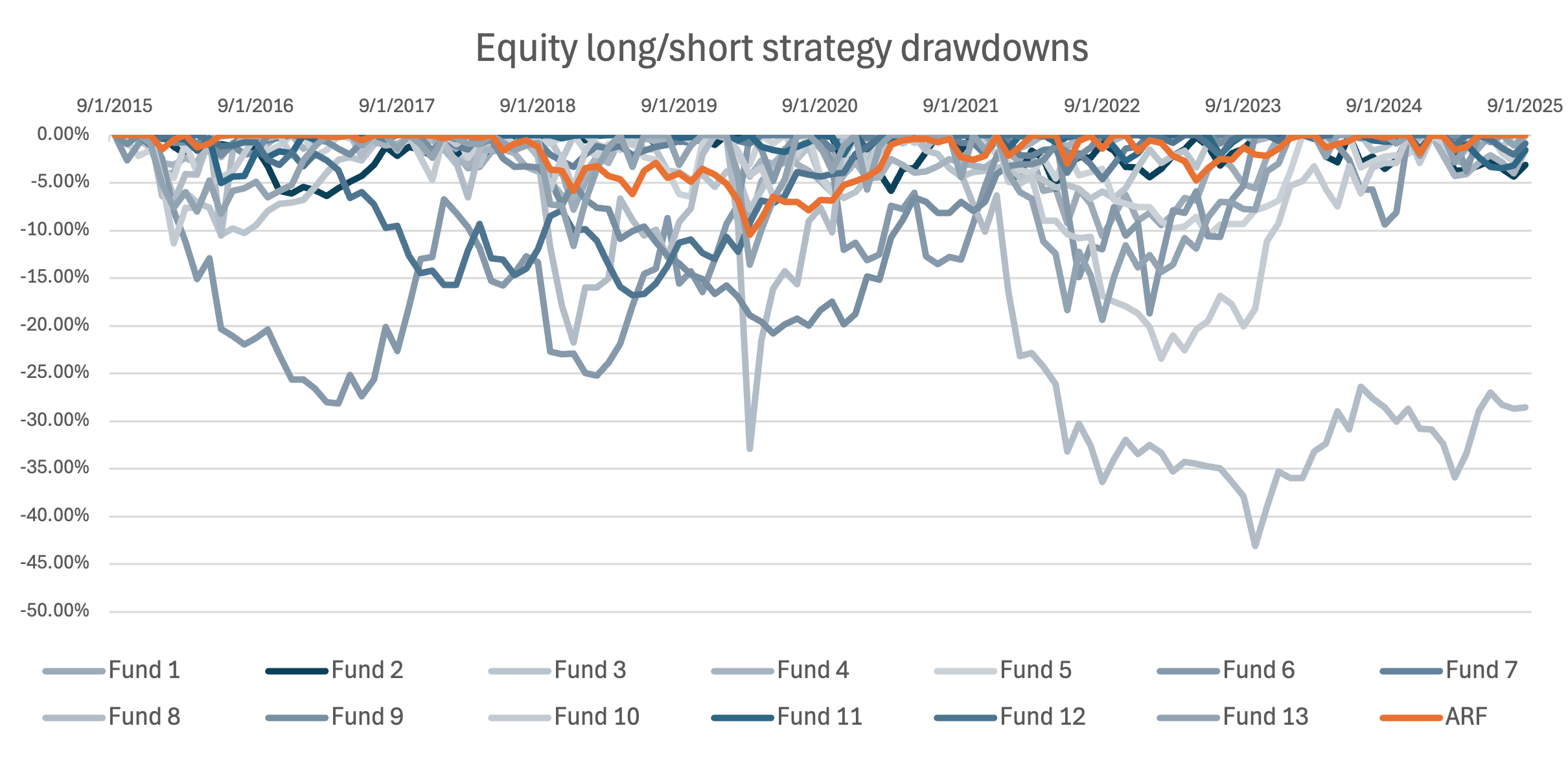
Source: Bloomberg, Fortem Capital, 31.10.2015 – 31.10.2025
And unsurprisingly often, in a period in which equity beta itself has been very rewarding, often it is equity beta that is being masked that is driving returns, and betas themselves can be fairly unstable through time:
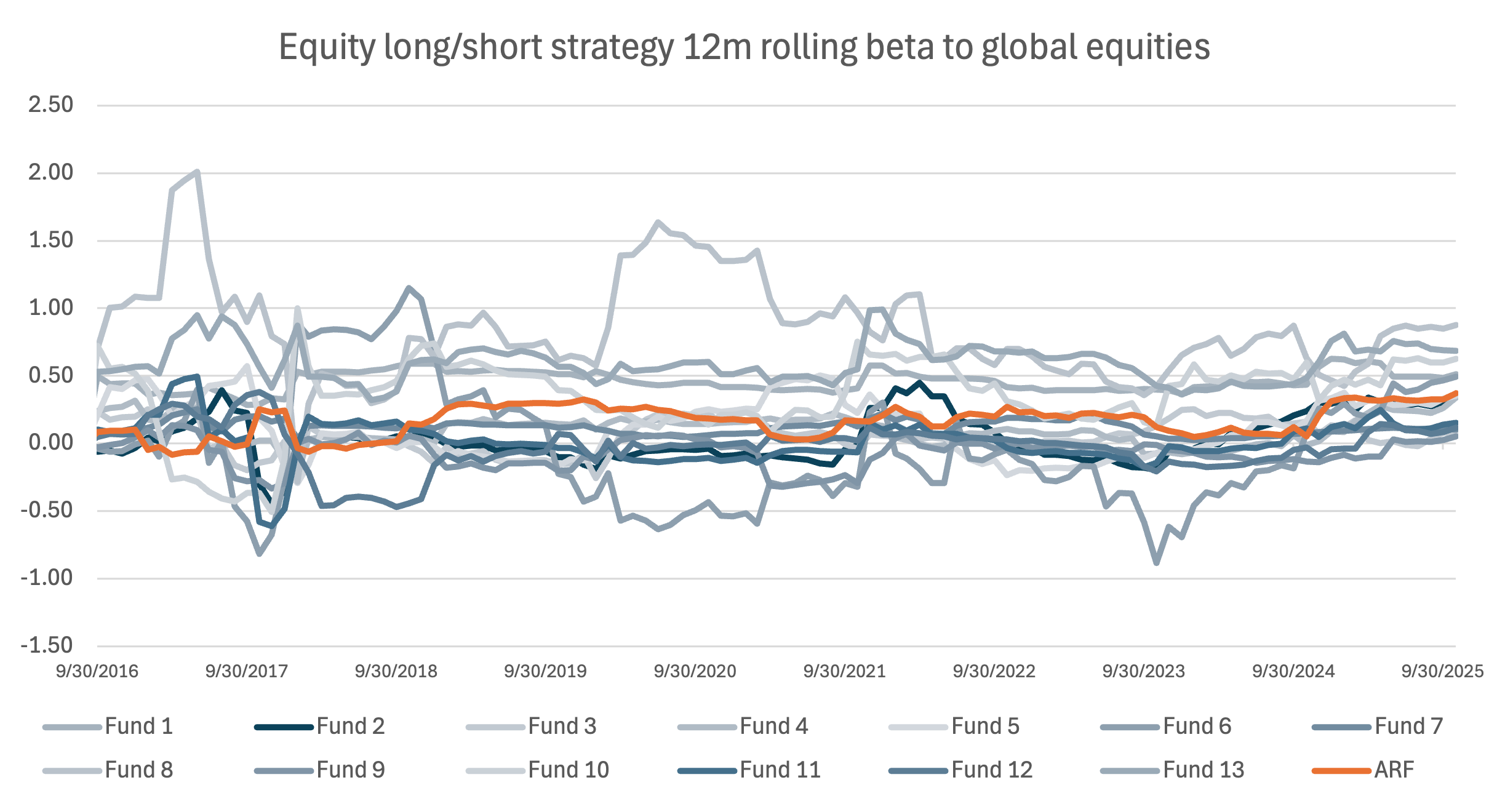
Source: Bloomberg, Fortem Capital, 31.10.2015 – 31.10.2025
Peer Comparison:
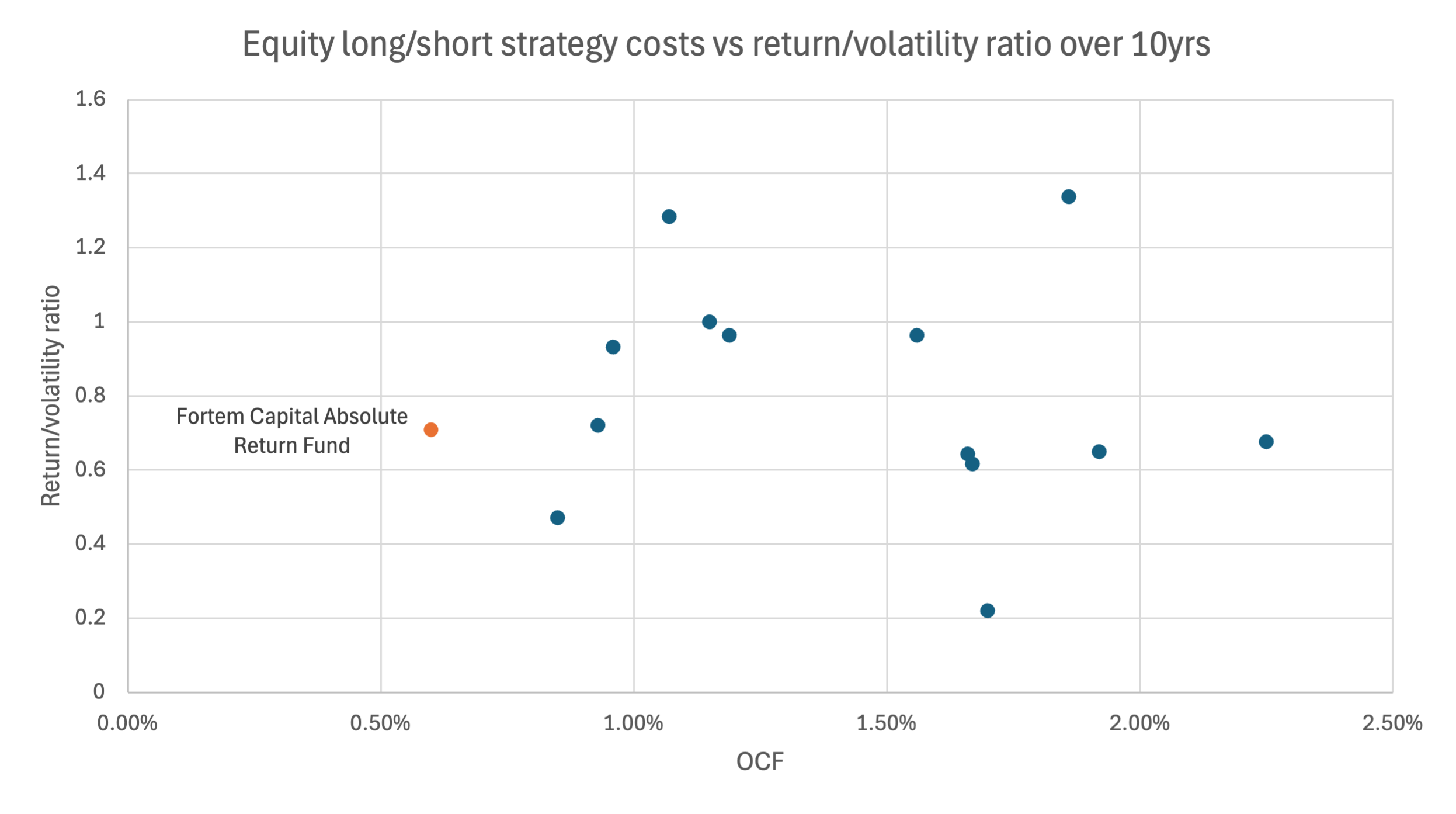
Return Efficiency vs Cost
The below scatter provides some measure of the cost effectiveness of each strategy by plotting return per unit of risk against the Ongoing Charges Figure (OCF):
Source: Bloomberg, Fortem Capital, 31.10.2015 – 31.10.2025
Headline returns in equity long/short often mask as much as they reveal. Strategies which appear strong may simply be repackaging equity beta or style concentration rather than delivering genuine diversification. Investors therefore risk paying hedge fund fees for exposures already embedded elsewhere in their portfolios which can be replicated far more efficiently.
The Fortem equity long/short strategy is transparent and predictable, has offered competitive return efficiency, in a non-optimal environment, at meaningfully lower cost, making it a natural core holding within an equity long/short allocation.
The strategy is not designed to completely replace high-conviction or tactical long/short strategies; it is designed to make them easier to hold.
As the stable, cost-efficient diversifier in the allocation, Fortem Capital Absolute Return provides the foundation upon which more expressive satellite positions can be built with confidence.
DISCLAIMER
- This document has been issued and approved as a financial promotion by Fortem Capital Limited for the purpose of section 21 of the Financial Services and Markets Acts 2000. Fortem Capital Limited registration number 10042702 is authorised and regulated by the Financial Conduct Authority under firm reference number 755370.
- This document is intended for Professional Investors, Institutional Clients and Advisors and should not be communicated to any other person.
- The information has been prepared solely for information purposes only and is not an offer or solicitation of an offer to buy or sell the product.
- Data is sourced from Fortem Capital Limited and external sources. The data is as at the date of this document and has been reviewed by Fortem Capital Limited.
- Information, including prices, analytical data and opinions contained within this document are believed to be correct, accurate and derived from reliable sources as at the date of the document. However, no representation or warranty, expressed or implied is made as to the correctness, accuracy or validity of such information.
- Fortem Capital Limited assumes no responsibility or liability for any errors, omissions or inaccuracy with respect to the information contained within this document.
- All price and analytical data included in this document is
intended for indicative purposes only and is as at the date
of the document.
- The information within this document does not take into account the specific investment objective or financial situation of any person. Investors should refer to the final documentation and any prospectus to ascertain all of the risks and terms associated with these securities and seek independent advice, where necessary, before making any decision to buy or sell.
- The product may not be offered, sold, transferred or delivered directly or indirectly in the United States to, or for the account or benefit of, any U.S. Person.
- The Fortem Capital Progressive Growth Fund is a Sub-Fund of Skyline, an open-ended investment company with variable capital incorporated on 1 June 2010 with limited liability under the laws of Ireland with segregated liability between Funds. The Company is authorised in Ireland by the Central Bank of Ireland pursuant to the UCITS Regulations.
For more information on the investment philosophy or any of Fortem’s investment offerings, please do not hesitate to contact the team, we would be delighted to hear from you